9 - Working Title Change, Combat System Details
I haven't updated this blog in a month - that's not because I haven't been working on the game, it's the opposite. I've been working on the game a lot and haven't had the drive to update the blog. I'm going to start posting in a weekly format to try and ensure that I keep interested people informed about the development. Some of these weekly uploads might just be a playtest or a video - others will be blog posts.
First off, I've decided to change the working title of the project. I started with Project BN2 because it was a no-effort name based on a friends initials with the 2 representing that this is the second time I've worked on a project in Unity. My brother Jake told me that the name was not super memorable, and if I was going to advertise this game before I had a proper title, I should get a better working title. So from now on, this project will be referred to as "Project Alder". I like this name because nothing comes up on google when you search for Project Alder, and Alder Town is the name of the Act 1 hub that a lot of the game will be based around. Without further ado, I'll dive into the details of the damage pipeline.
Damage is divided into two broad categories, each having three subcategories. There's Physical damage with Bludgeoning, Cutting, and Piercing as subcategories, and there's Magical damage with Fire, Ice, and Energy. The player has two damage stats: a physical damage stat and a magical damage stat. These stats are summed up from your primary attributes (Strength, Dexterity, Intellect, and Vitality), your equipment bonuses, and your skills (more on this later).
Each subcategory then has an additive multiplier (for example, +30% damage to piercing). Active skills (like sunder or the fireball, from the last blog post) have a multiplier attached to them which just indicates the damage of the skill (single target will do more than AoE for example). Finally, there are certain other multipliers or bonuses you can gain from investing in passive skills.
The final, pre-mitigation damage formula then looks like this (piercing damage example): Physical Damage * Piercing Additive Multiplier * Skill Damage Multiplier * Bonus Multipliers.
Mitigation is similar. You have two broad mitigation stats, and then fine-grained resists for the subcategories. The mitigation stats per type are Armor and Magic Armor. Subtype resistances go up to 70% linearly; this means that if you get a piece of equipment that says 10% fire resist, its just 10% fire resist. Armors on the other hand are based on attacker level - you'll need more armor to achieve 10% mitigation against a level 15 attacker than a level 10 attacker. Armors then, have a linear soft cap at 50% with an 80% hard cap that scales logarithmically after the soft cap is reached. The full 80% hardcap requires about 6x the armor as the soft cap. I'm designing this with the expectation that most players in the end game will try to reach the soft cap, but dedicated builds can show class fantasy through substantial mitigation.
Now to the mitigation formula. Damage taken is reduced by the subcategory resistance first, then the remaining is passed to the armor. So if my opponent attacks me for 100 piercing damage, and I have 70% piercing resist and 50% armor: I will take 100 * 0.3 * 0.5 = 15 damage. You can see from this that the mitigation cap is 94%.
Pic - some semi-complex combat logging (and the training dummy).
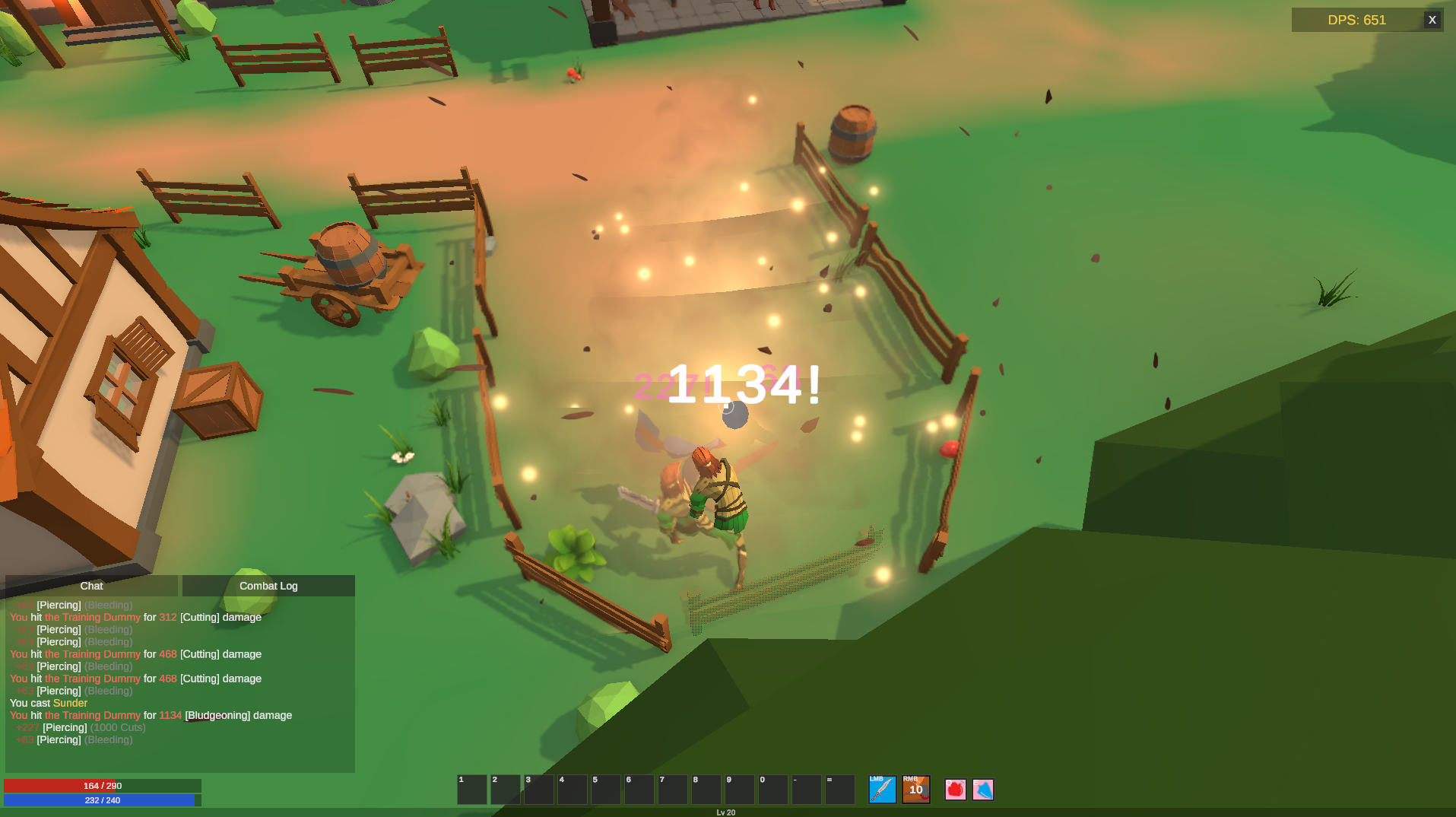
Now we come to the topic of hybrid damage. There is one skill I've added to the game called "Vicious Mana". This is a Rogue skill in the Dark Arts tree (I'll follow up at some point with descriptions of the skill trees I've decided on). This skill makes it so that your energy damage will do an additional 10/20/30% piercing damage. How is this piercing damage actually calculated - what does 30% additional piercing damage mean? Whenever we say an ability will do some percent or multiplier on a type of damage, we will calculate based off of the root damage type: for piercing that means physical. This means that this skill has you using your magic damage stat to deal energy damage, then your physical damage stat to deal the piercing damage. Think about this for a minute - I think that this enables the greatest build variety. It rewards players who (as a shallow tier 1 dip) have high physical/piercing damage but occasionally do energy damage (from a weapon proc or something) because that 30% piercing damage will actually end up being a lot. At the same time, it doesn't make sense as a pick for pure magic damage builds, so people won't just multiclass into the Dark Arts tree to pick up what would otherwise be a "free 30% damage".
I'll follow up this post in the next few days with a playtest video featuring the new Rogue class.
Comments